

Receiving a Notice of Intended Prosecution (NIP) can be an unsettling experience. Whether you've been accused of speeding, using a mobile phone behind the wheel or another road traffic offence, it's completely understandable to worry about the possibility of penalty points, a driving ban or increased insurance premiums. Unfortunately, scammers are becoming increasingly aware of this anxiety.
Across social media, online forums and unofficial websites, motorists are being targeted with promises of "legal loopholes" that claim to help them avoid prosecution. Some encourage drivers to name somebody else as the driver, while others advertise fake insurance policies or guarantee that penalty points can be made to disappear. While these offers may sound convincing, following this advice can lead to consequences far more serious than the original motoring allegation.
In many cases, motorists who attempt to "beat the system" end up facing criminal charges, substantial legal costs, a criminal record and, in the most serious cases, imprisonment.
What Is a Notice of Intended Prosecution (NIP)?
A Notice of Intended Prosecution (NIP) is a formal document issued by the police when they intend to prosecute certain road traffic offences. These commonly include speeding, careless driving, dangerous driving, failing to comply with traffic signals and other offences detected either by police officers or roadside enforcement cameras.
In most cases, the registered keeper of the vehicle will also receive a Section 172 requirement under the Road Traffic Act 1988, which legally requires them to identify who was driving the vehicle at the time of the alleged offence.
Many people mistakenly assume this is simply a request for information, but it is a legal obligation. The information provided must be accurate and truthful. Deliberately naming the wrong driver or providing false details is not treated as a minor administrative error - it is a criminal offence in its own right and can result in prosecution regardless of whether the original allegation would have led to conviction.
The Dangerous Myth of "Naming Someone Else"
One of the most common scams circulating online encourages motorists to nominate another person as the driver in an attempt to avoid penalty points or disqualification. Some fraudsters suggest that if the speed camera photograph is unclear, the police will be unable to prove who was behind the wheel. Others claim that having a friend or family member "take the points" is a harmless favour that is unlikely to be discovered.
This simply isn't true.
Police investigating motoring offences have access to a wide range of evidence when establishing who was driving a vehicle. Depending on the circumstances, investigators may examine ANPR records, CCTV footage, dashcam recordings, mobile phone data, insurance documents, DVLA records, witness statements and even social media activity where relevant. Modern investigations are often far more detailed than many motorists realise, particularly where inconsistencies begin to emerge. Attempting to mislead the police rarely makes the situation better. Instead, it often transforms what may have been a relatively straightforward motoring offence into a much more serious criminal investigation.
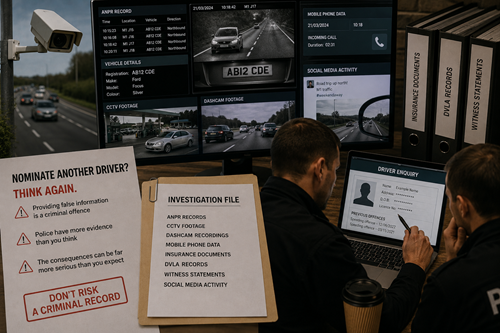
Providing False Driver Details Can Have Serious Consequences
Knowingly providing false information in response to a Notice of Intended Prosecution may amount to the common law offence of Perverting the Course of Justice - one of the most serious offences that can arise from a motoring investigation.
Unlike many driving offences, this is not dealt with by way of fixed penalties or modest fines. The courts have consistently shown that deliberately interfering with the justice system is viewed extremely seriously, even where the original offence was relatively minor.
There have been numerous high-profile cases in which motorists have received immediate custodial sentences after falsely naming another driver to avoid speeding penalties. What may initially seem like a way of avoiding three or six penalty points can ultimately result in a prison sentence, a criminal record and long-term consequences that affect employment, travel and future opportunities.
The punishment for attempting to avoid prosecution is often considerably more severe than the original offence itself.
Can You Rely on Advice Found Online?
The internet has made legal information more accessible than ever before, but it has also created opportunities for scammers to exploit motorists who are worried about losing their licence. Some websites and social media accounts claim they can "deal with" speeding tickets, guarantee acquittals or exploit supposed legal loopholes that prevent prosecution. Others offer to submit documents on a motorist's behalf or encourage people to provide false information in response to a Notice of Intended Prosecution.
The reality is that no legitimate legal professional can guarantee the outcome of a criminal case, and any individual encouraging you to provide inaccurate information is placing you at significant legal risk.
Even if you later argue that you were misled by poor advice or fell victim to a scam, this is unlikely to excuse providing false information to the police. Ultimately, responsibility rests with the person completing and returning the Notice of Intended Prosecution. If you are uncertain about your legal position, seeking advice from a regulated motoring law solicitor is always the safest course of action.
Fake Car Insurance Scams Are Also on the Rise
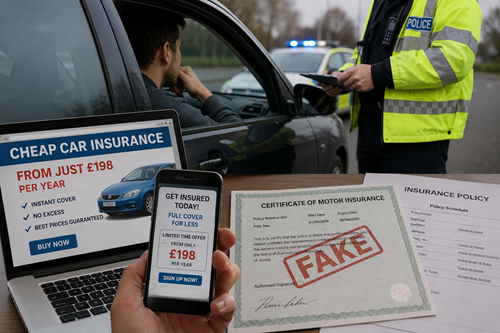
False driver details are not the only scam affecting motorists. Police and insurers have also warned about a growing number of fake car insurance policies being sold online. These fraudulent policies are often advertised through social media, messaging apps or unofficial brokers at prices that appear significantly cheaper than legitimate insurers. The paperwork can look convincing, with realistic policy documents and insurance certificates designed to appear genuine.
However, many motorists only discover the fraud after being stopped by the police or following a road traffic collision, at which point they learn they have never actually been insured.
Driving without valid insurance is a strict liability offence, meaning the prosecution does not need to prove that you intended to break the law. If you were driving without valid insurance, you can still face prosecution even if you genuinely believed the policy was legitimate. Conviction can result in penalty points, substantial fines, increased insurance premiums and, in many cases, the seizure of your vehicle.
Protecting Yourself
The best way to protect yourself is to approach any motoring allegation honestly and cautiously. If you receive a Notice of Intended Prosecution, take the time to read the documents carefully and ensure any information you provide is accurate. Never allow yourself to be persuaded into naming another driver unless they genuinely were driving the vehicle.
Similarly, be sceptical of websites or social media posts claiming they can guarantee the removal of penalty points or offer insurance at prices that seem too good to be true. If something appears suspicious, it probably is.
Most importantly, if you are unsure how to respond to a Notice of Intended Prosecution or are concerned about any aspect of a motoring allegation, seek advice from a specialist motoring solicitor before taking action. Receiving early legal advice is far safer than relying on unregulated online advice that could ultimately leave you facing far more serious consequences.
Speak to a Specialist Motoring Solicitor
Receiving a Notice of Intended Prosecution does not automatically mean you will be convicted, and every case should be considered on its own facts. However, attempting to avoid the process by following internet "loopholes" or fraudulent schemes can quickly turn a straightforward motoring allegation into a serious criminal matter.
If you have received a Notice of Intended Prosecution, been asked to identify the driver of a vehicle or require advice about any motoring offence, obtaining specialist legal advice as early as possible can help you understand your legal position, protect your rights and avoid making decisions that could have lasting consequences.