

Using a mobile phone whilst driving remains one of the most common motoring offences prosecuted in England and Wales. While most drivers are aware that making calls or sending messages behind the wheel is illegal, many are surprised to learn just how far the law now extends.
In recent years, police forces have introduced AI-assisted camera technology capable of identifying motorists who may be holding or using a mobile phone while driving. These systems are helping to detect more potential offences than ever before, even where no police officer is present at the roadside.
However, technology alone cannot determine guilt. Receiving a Notice of Intended Prosecution or a Fixed Penalty Offer does not automatically mean an offence has been committed. As with any criminal allegation, the prosecution must prove its case beyond reasonable doubt, and there are circumstances where motorists may have a legitimate defence.
This guide explains how the law applies, how AI cameras are changing enforcement, the penalties that may follow a conviction and the legal issues that can arise if you are accused of using a mobile phone whilst driving.
What Is the Law on Using a Mobile Phone Whilst Driving?
The law surrounding mobile phone use has changed significantly over the last decade. Many motorists still believe the offence only applies to making telephone calls or sending text messages, but the legislation now covers a much wider range of activities involving a handheld device.
In simple terms, the prosecution must prove three things before someone can be convicted. Firstly, that the person was driving. Secondly, that the device was handheld. Finally, they must show that the device was being used in a way prohibited by law.
If any one of these elements cannot be established, the offence may not be made out. Although some cases are relatively straightforward, others can involve complex legal and evidential issues, particularly where photographs or AI camera technology form the basis of the prosecution's case.
When Are You Considered to Be Driving?
One of the most common misconceptions is that you can only commit a mobile phone offence if your vehicle is moving.
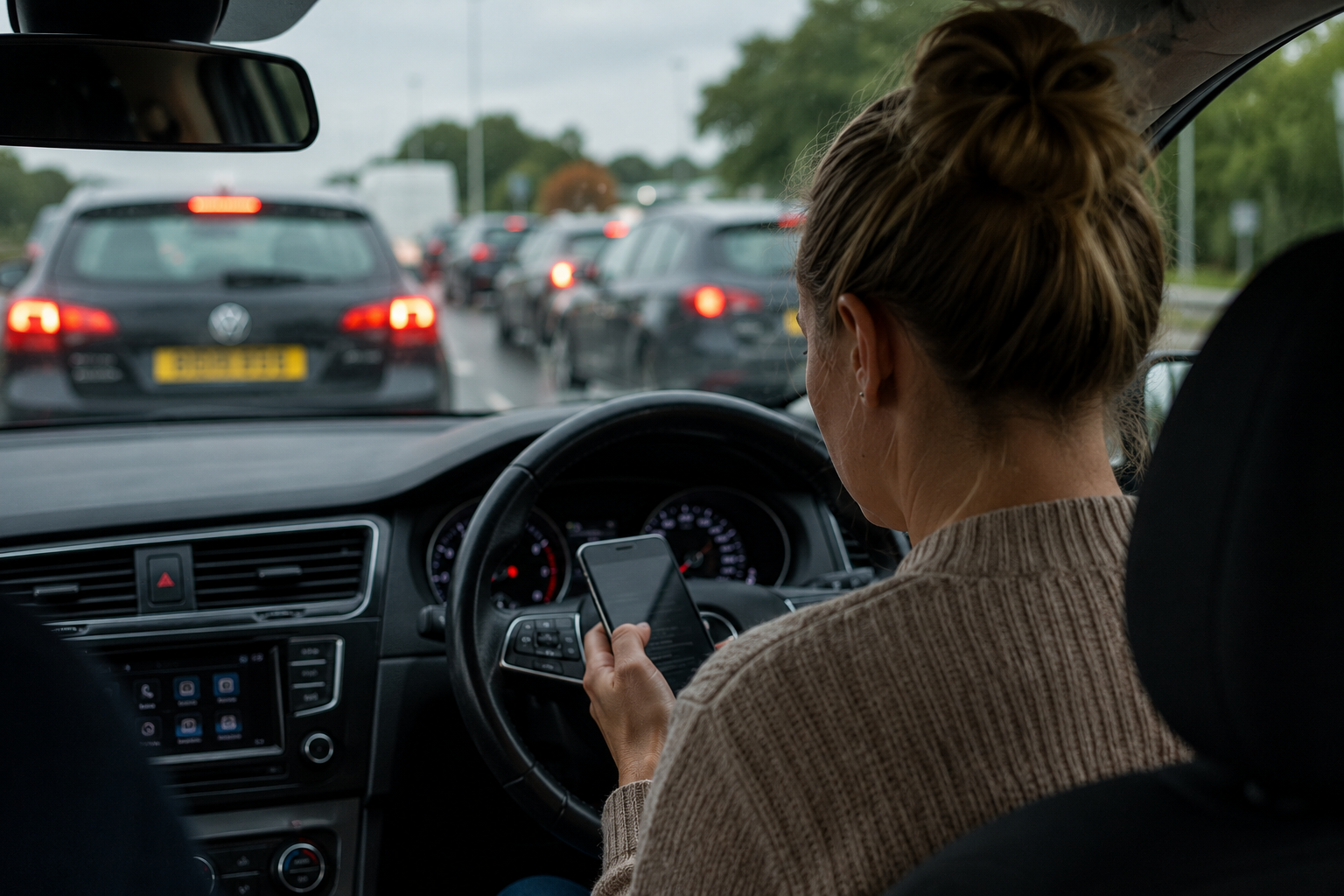
In reality, the legal definition of driving is much broader. A driver may still be regarded as driving while waiting at traffic lights, sitting in slow-moving traffic, queuing at roadworks or temporarily stopped at a junction. Although the vehicle is stationary, the journey is still ongoing and the driver remains responsible for controlling the vehicle and reacting to changing road conditions.
By contrast, someone who has safely parked their vehicle, switched off the engine and genuinely brought their journey to an end is far less likely to be considered driving for the purposes of the legislation. As with all motoring offences, however, every case depends on its individual facts.
What Counts as Using a Mobile Phone?
Many people are unaware that the offence extends well beyond making calls or sending messages. The legislation now covers a wide range of everyday interactions with a handheld device. Activities such as:
- checking notifications
- unlocking the screen
- browsing the internet
- using social media
- opening applications
- taking photographs
- recording videos
- or selecting music
may all amount to unlawful use if carried out whilst driving. The law was deliberately expanded to discourage almost all forms of handheld phone use behind the wheel. As a result, even relatively brief interactions can lead to prosecution if the necessary legal elements are present.
Are There Any Exceptions?
Not every interaction with a mobile phone is automatically unlawful.
The offence specifically relates to the use of a handheld device. If your phone is securely mounted in a suitable cradle, you may still be able to use functions such as satellite navigation or Apple CarPlay and Android Auto without committing the specific mobile phone offence. Likewise, using voice commands or a hands-free Bluetooth system will not usually fall within the legislation.
That said, drivers must remain in proper control of their vehicle at all times. If interacting with a mounted device causes a driver to become distracted or affects their standard of driving, the police may instead consider offences such as driving without proper control or careless driving.
| Permitted | Not Permitted |
|---|---|
| Calling 999 in a genuine emergency | Checking messages |
| Remote parking functions | Reading notifications |
| Contactless payment at a drive-through | Changing music while holding the phone |
| Safely parked vehicle | Browsing social media |
Why Are More Drivers Being Prosecuted?
While roads policing officers continue to play an important role in enforcing motoring laws, advances in technology have significantly increased the ability of police forces to identify potential offences. Many forces now use AI-assisted roadside cameras capable of analysing thousands of passing vehicles every day. These systems are designed to identify drivers who appear to be holding or using a mobile phone before referring the images for further review.
As these cameras become more widely deployed, motorists are increasingly likely to be detected, even where no police officer witnesses the alleged offence first-hand.
In the next section, we'll explain exactly how AI mobile phone cameras work, what they can and cannot detect, and why an AI-generated image alone does not automatically prove that an offence has been committed.
Did you know? AI camera technology can identify potential mobile phone use from high-resolution images, but the images are reviewed before enforcement action is considered.
Part 2
How Do AI Mobile Phone Cameras Work?
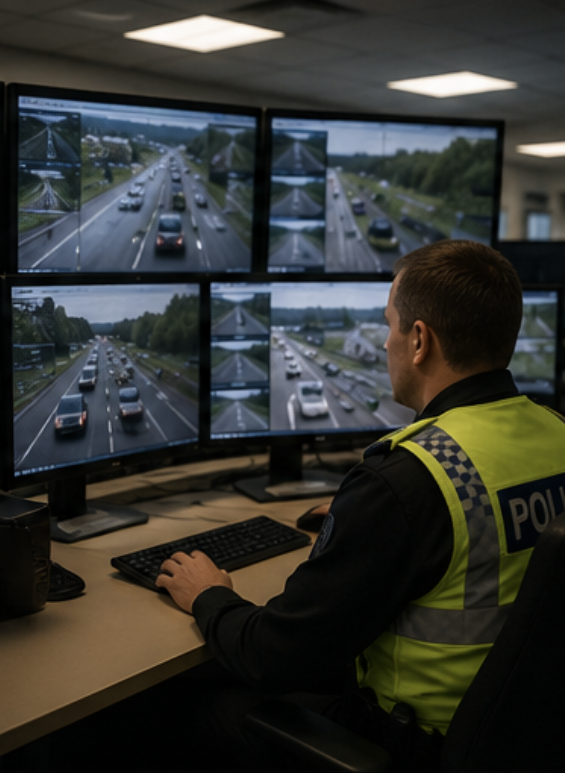
Technology is playing an increasingly important role in the enforcement of motoring offences, and mobile phone use is no exception. While roads policing officers continue to detect drivers using handheld devices, many police forces now also deploy AI-assisted camera systems capable of monitoring thousands of passing vehicles each day.
These cameras are designed to identify motorists who may be holding or using a mobile phone whilst driving. Their introduction has significantly increased the number of potential offences that can be detected, particularly on busy roads where it would be impossible for police officers to observe every passing vehicle.
As more police forces invest in this technology, drivers are far more likely to be identified than they were just a few years ago.
What Does an AI Camera Actually Look For?
Despite the name, AI cameras do not "understand" whether an offence has been committed. Instead, they analyse images of passing vehicles and look for visual features that may indicate a driver is holding or interacting with a mobile phone. This may include the position of a driver's hands, the shape of an object being held or whether the object resembles a mobile device.
If the system detects what appears to be a potential offence, the image is flagged for further review. This means AI is used as a screening tool rather than a decision-maker.
Does AI Automatically Issue Penalties?
No. One of the biggest misconceptions is that AI cameras automatically generate fines or prosecute motorists without human involvement. That is not how the process works.
Where a camera identifies what appears to be a mobile phone offence, the images are reviewed by a trained member of police staff before any enforcement decision is made. They will consider whether the evidence appears to show all of the legal elements of the offence and whether there is sufficient evidence to justify further action.
Only after this review may a Notice of Intended Prosecution or other enforcement action be considered. Ultimately, if a driver disputes the allegation and the matter proceeds to court, it is for the prosecution to prove the offence beyond reasonable doubt.
"AI cameras don't decide guilt. They simply identify potential offences that are then reviewed by trained personnel."
Can AI Cameras Make Mistakes?
Like any technology, AI-assisted cameras are not infallible. Although they are becoming increasingly sophisticated, they rely on image recognition rather than human judgement. As a result, objects held by a driver may sometimes resemble a mobile phone when they are not.
For example, depending on the angle or quality of an image, everyday items such as a wallet, glasses case, sandwich or other small object could potentially be flagged for further review. This does not mean an innocent driver will automatically be prosecuted. It simply means the image has been identified as one that requires closer examination.
If there is any uncertainty about what is shown in a photograph, or if the prosecution cannot clearly establish that the object is a mobile phone being used in a prohibited manner, those issues may become highly relevant should the allegation be challenged.
AI Evidence Still Needs to Be Proven
Even where an AI camera captures a clear image, that photograph alone does not automatically prove that an offence has been committed. The prosecution must still demonstrate that the driver was legally driving, that the device was handheld and that it was being used in a way prohibited by the legislation.
Evidence may include:
- Camera images
- Video footage
- Police officer observations
- Witness evidence
- Admissions made by the driver
- Mobile phone records (where relevant)
In some cases, these issues are straightforward. In others, they may be open to challenge, particularly where photographs are unclear or capable of more than one interpretation. As with any criminal allegation, the burden of proof remains with the prosecution throughout.
Why AI Cameras Are Likely to Become More Common
Police forces across the UK continue to explore new ways of improving road safety and detecting dangerous driving behaviour.
AI-assisted enforcement allows large numbers of vehicles to be monitored with greater efficiency than traditional roadside policing alone. As the technology develops, it is likely that more forces will introduce similar systems and that image quality and detection capabilities will continue to improve.
For motorists, the message is clear. The chances of being detected for using a handheld mobile phone whilst driving are increasing, and relying on the belief that "nobody will see" is becoming an increasingly risky assumption.
Part 3
What Evidence Does the Prosecution Need?
Receiving a Notice of Intended Prosecution or a court summons does not automatically mean a driver will be convicted. Like any criminal allegation, the burden of proof remains with the prosecution throughout the case.
To secure a conviction, the prosecution must prove that the driver was legally driving, that the device was handheld, and that it was being used in a way prohibited by law. If there is insufficient evidence to establish any one of these elements beyond reasonable doubt, the allegation may not succeed.
The strength of the evidence will vary from case to case. Some prosecutions rely on the observations of a police officer, while others are based on photographs captured by AI-assisted camera systems. Regardless of how the allegation arises, the evidence must still be capable of proving each element of the offence.
Can You Challenge the Evidence?
Every case should be considered on its own facts, and there are circumstances where the evidence may be open to challenge.
For example, if a photograph does not clearly show the object being held, it may not be possible to prove that it was a mobile phone. Equally, even if a mobile phone can be identified, the prosecution may still need to establish that it was being used in a way prohibited by the legislation.
Photographs only capture a single moment in time. Depending on their quality and the angle from which they were taken, they may not always provide a complete picture of what occurred. Where there is genuine doubt about what the evidence shows, those issues may become significant if the matter proceeds to court.

What Defences May Be Available?
There is no single defence that applies to every mobile phone allegation. Whether a driver has a realistic defence will depend entirely on the individual circumstances of the case and the evidence available.
In some cases, the issue may be whether the prosecution can prove the object shown was actually a mobile phone. In others, it may be disputed whether the driver was legally driving at the time, or whether the device was being used in a way that falls within the legislation.
Every allegation should therefore be carefully assessed on its own merits. Accepting a Fixed Penalty or pleading guilty without first understanding the strength of the prosecution's evidence may not always be the right course of action.
What Are the Penalties for Using a Mobile Phone Whilst Driving?
The penalties for using a handheld mobile phone while driving are among the most severe for common motoring offences. In many cases, drivers may be offered a Fixed Penalty Notice, provided they accept the allegation and are eligible to receive one. This normally results in six penalty points being endorsed on the driving licence together with a £300 fine.
Not every driver will qualify for a Fixed Penalty. If accepting the penalty would take a motorist to 12 or more penalty points within a three-year period, the matter will usually be referred to court instead.
What Happens If the Case Goes to Court?
A mobile phone offence may also proceed to court if the allegation is disputed or if the driver is not eligible for a Fixed Penalty Notice. If convicted, the court has the power to impose six penalty points together with a financial penalty based on the offender's income. In addition to any fine, the court may also order the payment of prosecution costs and the statutory victim surcharge.
Although the number of penalty points remains the same whether the matter is dealt with by Fixed Penalty or in court, the overall financial consequences of court proceedings are often considerably greater.
Could You Lose Your Licence?
For some motorists, six penalty points can have far more serious consequences than a financial penalty alone.
Drivers who already have points on their licence may find that a further six points places them at risk of reaching the 12-point threshold, commonly known as "totting up." In these circumstances, the court must normally impose a driving disqualification unless the driver can successfully argue that a ban would cause exceptional hardship.
New drivers face an additional risk. If someone accumulates six or more penalty points within the first two years of passing their driving test, their licence may be revoked under the New Drivers Act. This is not a discretionary disqualification imposed by the court but an administrative consequence of the driver's licence status. They would need to apply for a new provisional licence and pass both the theory and practical driving tests again before regaining full driving entitlement.
Obtaining Early Legal Advice
Receiving a Notice of Intended Prosecution or a court summons does not automatically mean a conviction is inevitable. Every allegation depends on the evidence and the circumstances of the individual case.
Obtaining specialist legal advice at an early stage can help drivers understand the strength of the prosecution's case, identify any potential issues with the evidence and make informed decisions about how best to deal with the allegation.
Whether that involves accepting a Fixed Penalty, making representations to the police or defending the matter before the court will always depend on the facts of the individual case.